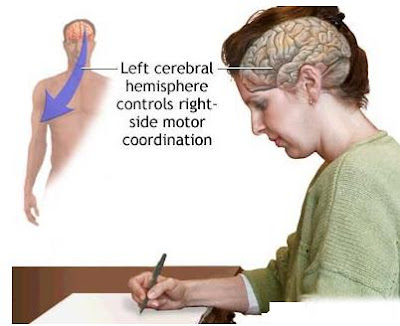
The cerebral hemispheres are the two longitudinal halves into which the cerebrum is divided. The cerebrum (brain) is divided into two hemispheres; a left cerebral hemisphere and a right cerebral hemisphere. These two hemispheres are joined together by the corpus callosum, which is a thick band of white matter made up of myelinated axons connecting the left hemisphere cortex to the right hemisphere cortex. Each cerebral hemisphere takes care of one side of the body, but the motor controls are crossed: the right hemisphere controls the left side of the body, whereas the left hemisphere controls the muscular contractions of the right side of the body.Although the cerebral hemispheres are very similar in appearance, they differ in their function in most people. The left hemisphere is analytical, logical, and linear, whereas the right is wholistic, intuitive, creative and imaginative. But the most concrete evidence of hemispheric lateralization for one specific ability is language. The major areas involved in language skills, Broca's area and Wernicke's area, are in the left hemisphere. Perceptual information from the eyes, ears, and rest of the body is sent to the opposite hemisphere, as motor impulses are sent out to the opposite side of the body; this is due to the crossing over of motor fibers at the pyramid of the medulla oblongata.