Friday, October 3, 2008

Stroke (Cerebrovascular Accident)

Stroke is the loss of brain functions due to a hindrance to the normal blood flow in the brain. As they do not receive oxygen-rich blood, the nerve cells in the affected area of the brain begin to die within minutes after the blood has stopped circulating.

There are two kinds of stroke. One kind of stroke is caused by a blood clot which plugs a blood vessel in the brain; this stroke is often referred to as thrombosis. The other kind of stroke is caused by a cerebral hemorrhage due to a blood vessel rupture; this happens when the blood pressure rises to very high levels to a point where a blood vessel can no longer withstand the inner pressure, bursting and bleeding, thus interrupting the normal blood supply to the neurons.

Stroke can cause serious neurological damage, rendering the affected person unable to move one or both limbs on one side of the body, and also leading to inability to understand and produce speech. Depending on the area of the brain where the blood flow stops, a stroke can sometimes cause death, especially when there is a massive brain hemorrhage.

Also called cerebrovascular accident, or ictus, stroke symptons arise suddenly and they are weakness of the face, arm drift, abnormal speech, confusion, trouble seeing in one or both eyes, trouble walking, loss of balance, dizziness, headache. When this happens people should immediately called for assistance.


Wednesday, October 1, 2008

Blood Vessels

Located throughout the body, the blood vessels are hollow, elastic tubes through which the blood flows, forming a network of interconnecting arteries, arterioles, capillaries, venules, and veins. Besides circulating blood, the blood vessels provide two important means of measuring vital health statistics: pulse and blood pressure. The blood vessels are part of the circulatory system.

Arteries are the passageways through which the blood circulates, the largest of which is the aorta. The aorta branches off the heart and divides into many smaller arteries called arterioles, which have muscular walls that adjust their diameter to increase or decrease blood flow to a particular body area. Arteries and arterioles carry oxygenated blood from the lungs to the rest of the body.

Capillaries are thin walled, highly branched vessels that feed the tissues and collect wastes and carbon dioxide to be carried back to the lungs, liver, or kidney for elimination. Capillaries empty into the venules, which in turn drain into the veins that lead back to the heart, which in turn pumps deoxygenated blood to the lungs to pick up more oxygen, and then back to the heart once again.

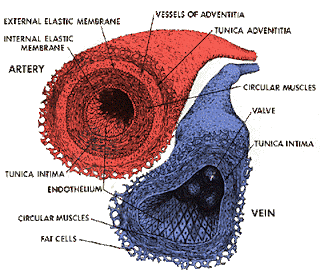
Arteries and veins have the same basic structure as they are made up of three layers of tissues: 1) elastic tissue called tunica intima; 2) smooth muscle, tunica media; 3) connective tissue, tunica adventitia. The walls of arteries contain smooth muscle fibre that contract and relax under the instructions of the sympathetic nervous system. Arterioles are also under the control of the sympathetic nervous system, as they constrict and dialate to regulate blood flow. Capillary walls are only one cell thick, which allows exchanges of material between the contents of the capillary and the surrounding tissue.